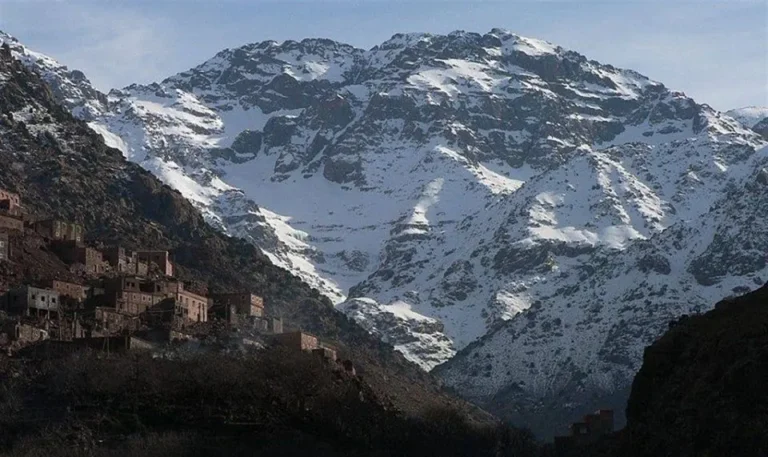
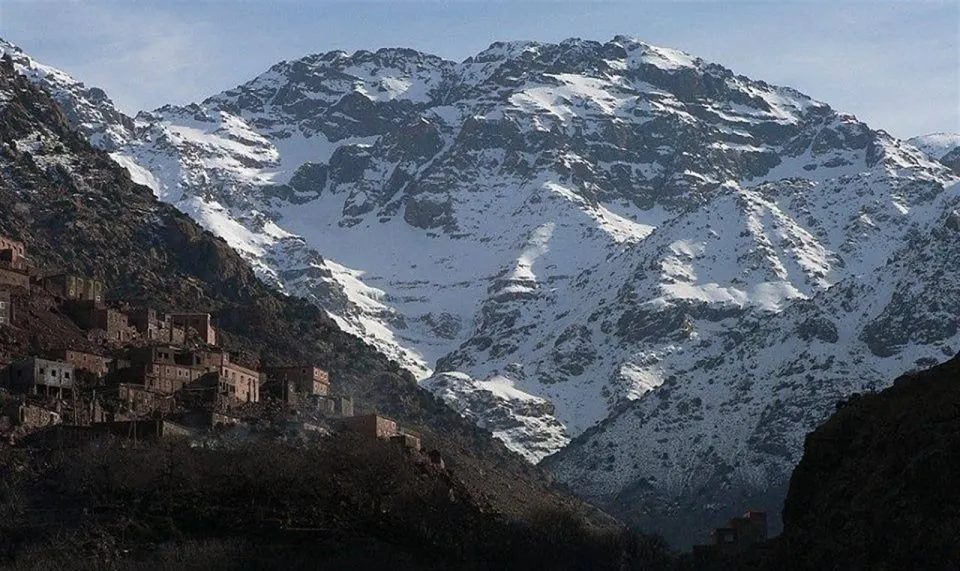
Jebel Toubkal rises to 4,167 m, the highest summit in North Africa, about 60 km south of Marrakech. In summer you can reach the top without technical climbing, which is why so many trekkers attempt it. What decides the experience is altitude, the season and how much time you give yourself. This guide covers the route, the difficulty, the guide rule and the best months, then the two ways we climb it.
Toubkal at a glance
| Height | 4,167 m |
|---|---|
| Usual start | Imlil, 1,740 m |
| Night before the summit | A refuge below the summit (on our circuit, the Neltner refuge at 3,207 m) |
| Guide | Licensed guide required in Toubkal National Park |
| Best months | April to May, September to October |
| Winter | Snow and ice: crampons and ice axe needed |
The route from Imlil
The standard ascent starts in Imlil. The first day climbs from the village to the refuges below the summit. Summit day starts before dawn: you climb to the top, then walk back down, either to Imlil the same day or to the refuge for a second night. Many trekkers add a night in Imlil before the climb so that the pace is less rushed.
On our Toubkal circuit, summit morning starts from the Neltner refuge (3,207 m) and finishes back in Imlil (1,740 m) the same day, a descent of almost 2,500 m from the top.
The refuges and acclimatisation
Two refuges stand below the summit: the Toubkal refuge of the French Alpine Club, built as the Neltner hut and used by hikers since the 1920s, and the Les Mouflons refuge next to it. Both serve as the base for summit day. The usual rule at altitude is to climb high and sleep low, and above 2,500 m to gain about 500 m of height per day. Itineraries that give you a night or two between 2,000 and 3,000 m before summit day follow that rule.
How hard is Mount Toubkal?
Toubkal is a strenuous hike. In summer it needs no ropes or technical gear; in winter it needs snow skills. The effort comes from three things:
- Altitude. Above 3,000 m many people feel the thinner air: breathlessness, headaches, dizziness or nausea.
- Terrain. Steep, rocky ground, tiring both going up and coming down, and a long descent after the summit.
- Cold and early start. Summit mornings begin in the dark, and the temperature at the top is far below that of the valleys.
Climb slowly and drink regularly. If a headache becomes severe and keeps worsening, or if you start vomiting or lose coordination, descend to a lower altitude straight away. Toubkal is not a good first walk for people who do not usually hike; a gentler Atlas trek is a better start.
Do you need a guide for Toubkal?
Yes. Since 2019, foreign trekkers must hire a licensed mountain guide inside Toubkal National Park, and there are checkpoints on the way up from Imlil. Rules can change, so confirm the current requirements before you go. A guide also reads the weather and the snow conditions, which matter more on Toubkal than on any other walk in the area.
Best time to climb Toubkal
April to May and September to October avoid both the summer heat in the valleys and the winter snow at the top. September and October are often clearer, with fewer trekkers on the trail. July and August are hot lower down but give clear summits. From November to April the mountain is under snow and ice, and the ascent becomes a winter climb: crampons, ice axe and winter boots are essential.
Two ways to climb Toubkal with us
Toubkal circuit via Lake Ifni, 6 days
A loop from Imlil around the south side of the massif before the summit: Tizi n’Tamatert (2,279 m), Ouansekra, Tizi n’Likemt (3,550 m), the Amsouzart valley, Lake Ifni (2,295 m), then Tizi n’Ouanoums (3,670 m) to the Neltner refuge and the summit on day 6. By summit morning you have already crossed two passes above 3,500 m. From €355 per person.
Mount Toubkal and the Merzouga dunes, 5 days
Imlil to the Toubkal refuge on day 1, the summit and the descent to Aremd on day 2, then three days by road to the desert: Ait Ben Haddou, the Dades Valley, the Todra Gorge and the Merzouga dunes. From €460 per person.
Which one? Choose the circuit if the mountain is the goal and you want to reach the summit after several days of walking. Choose the 5-day trip if you want the summit and the Sahara in a single week.
Prices are per person for a group of 4 or more; each trip page shows the price for 2 and 3 people.
What to pack for Toubkal
- Walking boots you have already worn in; mountaineering boots in winter.
- A warm insulated jacket, hat and gloves for summit morning, in every season.
- Layers you can add and remove during the day.
- Head torch for the pre-dawn start.
- Sun hat, sunglasses and sun cream.
- From November to April: crampons and an ice axe.
Questions
How high is Mount Toubkal?
4,167 m (13,671 ft), the highest summit in North Africa.
How long does it take to climb Toubkal?
The standard ascent from Imlil takes two days, often three with a night in Imlil first. Our Toubkal circuit reaches the summit on day 6 of a loop; our Toubkal and Merzouga trip reaches it on day 2.
Do you need a guide for Toubkal?
Yes. Foreign trekkers must hire a licensed mountain guide inside Toubkal National Park, a rule in force since 2019.
Is Toubkal hard for beginners?
It is a strenuous hike at high altitude. Fit walkers manage it in summer; people who do not usually hike should start with a gentler Atlas trek.
Sources
- Height 4,167 m, highest in North Africa: www.exploreworldwide.com
- About 60 km south of Marrakech: www.mountainiq.com
- Strenuous, no technical gear in summer, snow skills in winter; classic two-day ascent from Imlil: www.exploreworldwide.com
- Three-day itinerary with a night in Imlil; September-October clearer, fewer trekkers: www.nomadotravel.app
- Guide mandatory since 2019; checkpoints: worldfootprints.com
- Dizziness and nausea common altitude symptoms: www.bewilderedinmorocco.com
- Altitude safety: descend on severe headache, vomiting, loss of coordination: jessieonajourney.com
- Best months Apr-May and Sep-Oct: www.responsibletravel.com
- Not for people not used to walking: www.responsibletravel.com
- Winter Nov-Apr: crampons, ice axe; Neltner hut since 1920s: globalsummitguide.com
- Les Mouflons and CAF refuges; climb high sleep low, ~500 m/day above 2,500 m: www.mountainiq.com