Most people who plan an Atlas Mountains trek start with Toubkal, then discover that the range is far larger than one summit. In Morocco the Atlas divides into three ranges, each with its own season and its own kind of walking. This guide helps you choose a region, a time of year and a trek length, using the routes we run as examples: from three days between two High Atlas valleys to nine days across Jebel Saghro.
The three Atlas ranges in Morocco
Moroccan trekking guides usually split the Atlas into the High Atlas, the Middle Atlas and the Anti-Atlas. The difference between them decides where you can walk, and when.
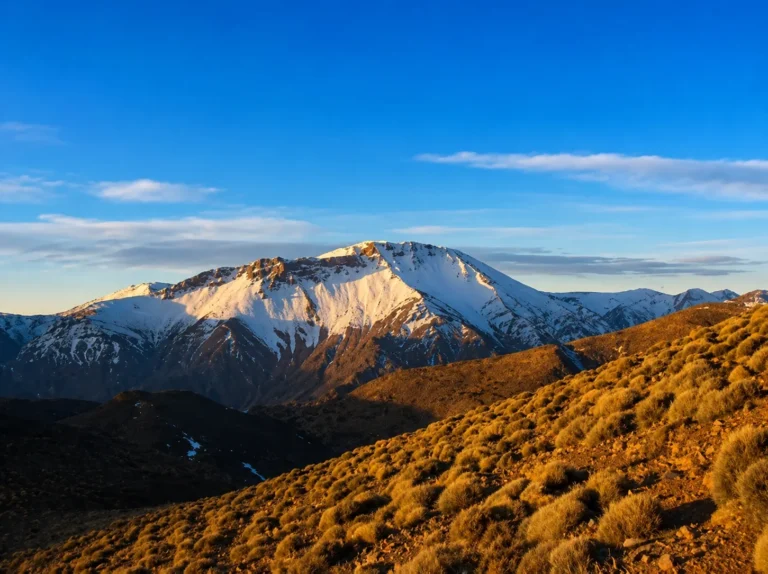
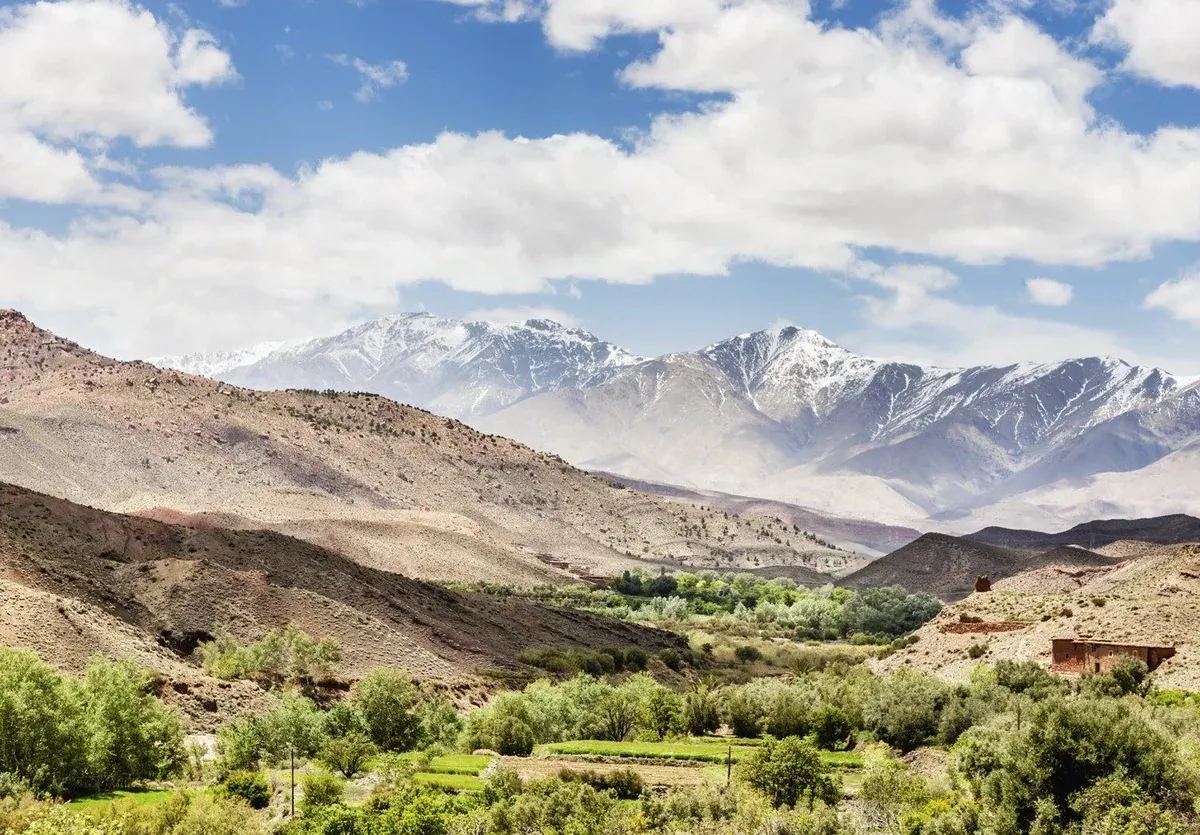
- High Atlas. The highest of the three. It holds Jebel Toubkal (4,167 m), the highest summit in North Africa, and further east M’goun (4,071 m), Morocco’s second-highest summit. Most multi-day treks in Morocco take place here: Berber villages, terraced fields, walnut trees and passes above 3,000 m.
- Middle Atlas. North of the High Atlas, lower and greener, known for cedar forests, waterfalls and plateaus.
- Anti-Atlas and Jebel Saghro. To the south, arid mountains on the edge of the Sahara. Jebel Saghro is the eastern continuation of the Anti-Atlas: volcanic rock, small oases and the nomads of the Ait Atta.
- Siroua. A volcanic massif between the High Atlas and the Anti-Atlas, with a summit at 3,305 m and villages known for weaving Berber carpets.
| Region | Highest point on our routes | Best months | Our treks |
|---|---|---|---|
| Toubkal area (western High Atlas) | Toubkal, 4,167 m | April to May, September to October | Toubkal circuit, Mini trek, Imlil to Setti Fatma, Ourika to Imlil |
| M’goun and Ait Bouguemez (central High Atlas) | M’goun, 4,071 m | April to May, September to October | M’goun trek, Family trek |
| Jebel Saghro | Kouaouch, 2,600 m | October to April | Saghro in 6 days, Saghro in 9 days |
| Siroua | Siroua summit, 3,305 m | October to May | Siroua trek |
When to trek in the Atlas Mountains
In the High Atlas, spring (April and May) and autumn (September and October) give the most comfortable conditions: strong sun, cool air and passes free of snow. In summer the lower valleys can reach around 29°C, while above 3,000 m you still need warm clothing. Snow usually arrives from late October or early November. Some high routes close in winter, and a winter ascent of Toubkal is a different undertaking that requires crampons and an ice axe.
The Anti-Atlas and Jebel Saghro work the other way round. There is no snow there, so the season runs from October to April, with sunny days and cold nights. If your holiday falls between December and February, Saghro is the natural choice. In July and August, stay high in the Toubkal or M’goun valleys and start walking early.
How many days do you need?
Three or four days fit easily into a stay in Marrakech and give a real taste of village life. Six days is the usual length for a circuit that includes a summit. Nine or ten days let you cross a whole massif and reach places few visitors see.
| Trek | Days | Highest point | From |
|---|---|---|---|
| Imlil to Setti Fatma via the Ourika Valley | 3 | Pass at 3,172 m | €175 |
| Mini trek to the Berber villages of Toubkal | 4 | Tougdalt pass, 2,700 m | €245 |
| Ourika Valley to Imlil | 6 | Tacheddirt pass, 3,170 m | €345 |
| Toubkal circuit via Lake Ifni | 6 | Toubkal, 4,167 m | €355 |
| M’goun and the Ait Bouguemez Valley | 6 | M’goun, 4,071 m | €380 |
| Siroua massif | 6 | Siroua, 3,305 m | €390 |
| Saghro massif | 6 | Kouaouch, 2,600 m | €435 |
| Jebel Saghro | 9 | Kouaouch, 2,570 m | €605 |
Prices are per person for a group of 4 or more; each trip page shows the price for 2 and 3 people.
How hard is it? Look at the highest point
The simplest way to judge an Atlas trek is its highest pass or summit, and how many days you spend above 3,000 m. A few examples from our routes:
- The 4-day mini trek stays below 2,700 m and spends each night in small traditional lodges in the villages.
- The Toubkal circuit crosses Tizi n’Likemt (3,550 m) and Tizi n’Ouanoums (3,670 m) before the summit. It is a demanding trek, designed for experienced hikers.
- The Rose Valley trek is not very physically demanding and can be walked with friends or children.
- The family trek in Ait Bouguemez is the route we recommend to families with children.
Altitude counts as much as distance. Above about 2,500 m the usual advice is to gain height slowly, so a route that climbs gradually is easier than its numbers suggest.
Do you need a guide in the Atlas Mountains?
Inside Toubkal National Park, foreign trekkers have been required to hire a licensed mountain guide since 2019. Rules can change, so check the current situation before you travel. Wherever you trek, a guide decides the route, the water points, the villages and the nights, which is most of what makes a multi-day trek work.
On routes such as the Toubkal circuit and the 9-day Saghro trek, meals are prepared by our cook, so your days are spent walking rather than organising.
Where you sleep on an Atlas trek
Nights depend on the route. The mini trek and the Ourika to Imlil trek use village lodges. The M’goun trek spends nights in tents, starting at Ikkis n’Arous (2,300 m). On the Toubkal circuit the night before the summit is at the Neltner refuge (3,207 m). The Rose Valley trek stays in typical homestay lodges.
Getting to the start of the trek
All the treks above start and finish in Marrakech. The Toubkal valleys are the closest: the start of the mini trek is about 1 hour 30 minutes by road. M’goun and Ait Bouguemez are reached via the Ouzoud waterfalls, and Jebel Saghro and Siroua via the Tizi n’Tichka pass.
What to pack
- Walking boots you have already worn in, and good hiking socks.
- Layers: a warm jacket for evenings and high passes, even in summer.
- Sun hat, sunglasses and sun cream: the sun is strong at altitude.
- A water bottle, a head torch and a small daypack.
- For winter ascents of Toubkal: crampons, ice axe and mountaineering boots.
Questions
What is the best month to trek the Atlas Mountains?
In the High Atlas, April to May and September to October. In Jebel Saghro and the Anti-Atlas, October to April, when there is no snow and the days are mild.
Can you trek the Atlas Mountains without a guide?
Inside Toubkal National Park, foreign trekkers must hire a licensed mountain guide, a rule in force since 2019. Check the current rules before you travel.
How many days do you need for an Atlas trek?
Three or four days give a good introduction from Marrakech. Six days is the usual length for a circuit with a summit such as Toubkal or M'goun.
Which Atlas trek is easiest?
On our routes, the 4-day mini trek stays below 2,700 m, the Rose Valley trek is not very physically demanding, and the Ait Bouguemez family trek is designed for families with children.
Sources
- Three Atlas ranges in Morocco: imliltrek.com
- Middle Atlas cedar forests, Anti-Atlas desert mountains: sites.google.com
- Seasons: High Atlas Mar-Oct, ~29C in summer valleys, snow from late Oct/early Nov, Anti-Atlas Oct-Apr: www.responsibletravel.com
- Guide mandatory in Toubkal National Park since 2019: globalsummitguide.com
- Rules can change, check current requirements: www.explore.co.uk
- Gain height slowly above 2,500 m: www.mountainiq.com
- Siroua 3,304 m in Anti-Atlas, best Oct-May: magazine-next.muchbetteradventures.com
- Winter: crampons, ice axe, mountaineering boots; worn-in boots: iantaylortrekking.com